video
Methyl Acrylate Structure

Methyl Acrylate Structure

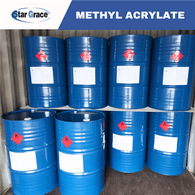
Purity: 98%
Application: Polymers and copolymers, Emulsion polymers, Impact modifiers for thermoplastics, Acrylic fibers
Recommended Products: Acrylic Acid, Ethyl Acrylate, Butyl Acrylate, Isooctyl Acrylate, Methyl Methacrylate (MMA), Methacrylate, Butyl Methacrylate
How to Order Star Grace Mining from Website:
Send inquiry and confirm purity + Target market → Star Grace confirm price + Lead time → Arrange production→ Pick up sample and test→ Devlier the cargo to customer→ Customer Receive the specified goods

Product Introduction

Why Star Grace Mining

product-960-600


product-960-700


product-969-197

Methyl Acrylate Structure
Basic Information
CAS No. 96-33-3
HS CODE 2916121000
Chemical formula C4H6O2
Appearance Colorless liquid

Transport Package

180kg Drum
Melting point −74 °C (−101 °F; 199 K)
Boiling point 80 °C (176 °F; 353 K)
density 0.9± 0.1g /cm3
Origin China
What Is Methyl Acrylate Structure?

Methyl acrylate is an organic compound with the chemical formula C₄H₆O₂. It is an ester of acrylic acid and methanol. The methyl acrylate structure can be represented as follows:   

      O
       ‖
H₂C=CH-C-O-CH₃

In this structure:

The central carbon atom is attached to a hydrogen atom (H₂C=), a vinyl group (-CH=), and a carbonyl group (=C=O).

The carbonyl group is connected to a methoxy group (-O-CH₃).

This structure gives methyl acrylate its characteristic properties, such as its reactivity and use in the production of polymers. The carbon-carbon double bond in the vinyl group makes methyl acrylate susceptible to polymerization, which is an important application of this compound.

Benefits of Methyl Acrylate Structure

1. Polymerization Reactivity:
The carbon-carbon double bond in methyl acrylate makes it highly reactive and susceptible to polymerization, enabling the formation of polymers.
This reactivity allows for the synthesis of a wide range of polymeric materials with diverse properties.


2. Copolymerization:
Methyl acrylate can be copolymerized with other monomers, such as styrene, acrylic acid, or other acrylates.
Copolymerization allows for the tuning of the physical, chemical, and mechanical properties of the resulting polymers to suit specific applications.


3. Adhesive Properties:
Polymers and copolymers containing methyl acrylate often exhibit good adhesive properties, making them suitable for use in adhesives, sealants, and coatings.
The ester group in methyl acrylate can contribute to the adhesion characteristics of the polymer.


4. Flexibility and Toughness:
Polymers derived from methyl acrylate tend to be more flexible and tough compared to some other acrylate esters.
This property makes them suitable for applications where flexibility and impact resistance are important, such as in paints, coatings, and sealants.


5. Compatibility with Other Materials:
Methyl acrylate-based polymers can be compatible with a wide range of other materials, including metals, plastics, and textiles.
This versatility allows for the development of diverse polymer-based products and composites.


6. Thermal and Chemical Resistance:
Polymers containing methyl acrylate can exhibit good thermal and chemical resistance, depending on the specific composition and formulation.

Product Photo

product-960-480

COA

product-960-300

Loading Photo

product-960-480

Meet Our Team

product-960-450

Hot Tags: methyl acrylate structure, China, suppliers, manufacturers, factory, producer, buy, price, made in China
Send Inquiry

whatsapp

skype

E-mail

Inquiry

Bag