




Why Star Grace Mining


| K2SO4 K2O 52%min | |
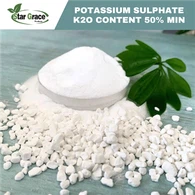
| INTRODUCE | Star Grace has two types of potassium sulfate, with the main content being K2O at 50% and K2O at 52%. Potassium sulfate has a lower salt index than most potash fertilizers, making it the preferred choice when soil salinity is a concern. It's not typically found as an existing compound in nature and therefore must be manufactured. |
| THE MANNHEIM PROCESS |
Traditionally, sulphate of potash has been produced by the Mannheim process, in which KCl is reacted with sulfuric acid to yield K2SO4 K2O 52%min. Although this method does work, it produces the desired compound as a byproduct; the primary product resulting from the process is HCl.
This process consists of first carrying out an exothermic reaction between potassium chloride (KCl) and sulfuric acid (H2SO4) and then an endothermic reaction between potassium chloride (KCl) and potassium bisulfate (KHSO4) to produce HCl and K2SO4 K2O 52%min.
The resulting K2SO4 K2O 52%min is cooled in a rotary cooler and may then be further finished into the desired product form. While the Mannheim process is still in use, it has largely given way to an alternative method: extraction from natural complex salts. |
| COMPLEX SALT PROCESSING |
Naturally existing complex salts can also provide a source of potassium sulfate. Here, potassium- and sulfate-bearing minerals are altered to remove byproducts, leaving potassium sulfate behind.
This process is highly complex and contributes to the high cost of SOP (K2SO4 K2O 52%min). A high-level overview of the process could be described as ore preparation and flotation, conversion to and leaching of schoenite, and finally, moisture reduction in a rotary dryer. This process may differ depending on the complex salt being treated. |
Product Photo

COA

Loading Photo

Our Loyal Customers

Meet Our Team

Hot Tags: K2SO4 K2O 52%min, China, suppliers, manufacturers, factory, producer, buy, price, made in China